Rule 6
HTTPS
Whether the site opens over an encrypted connection. Anything typed into a plain http page travels unprotected, and weak security carries the highest fine.
Type your website. In about 10 seconds you see what the DPDP Act would flag on it, with the section and the fine for each gap.
No sign-up. Reads public pages only. Nothing is stored.
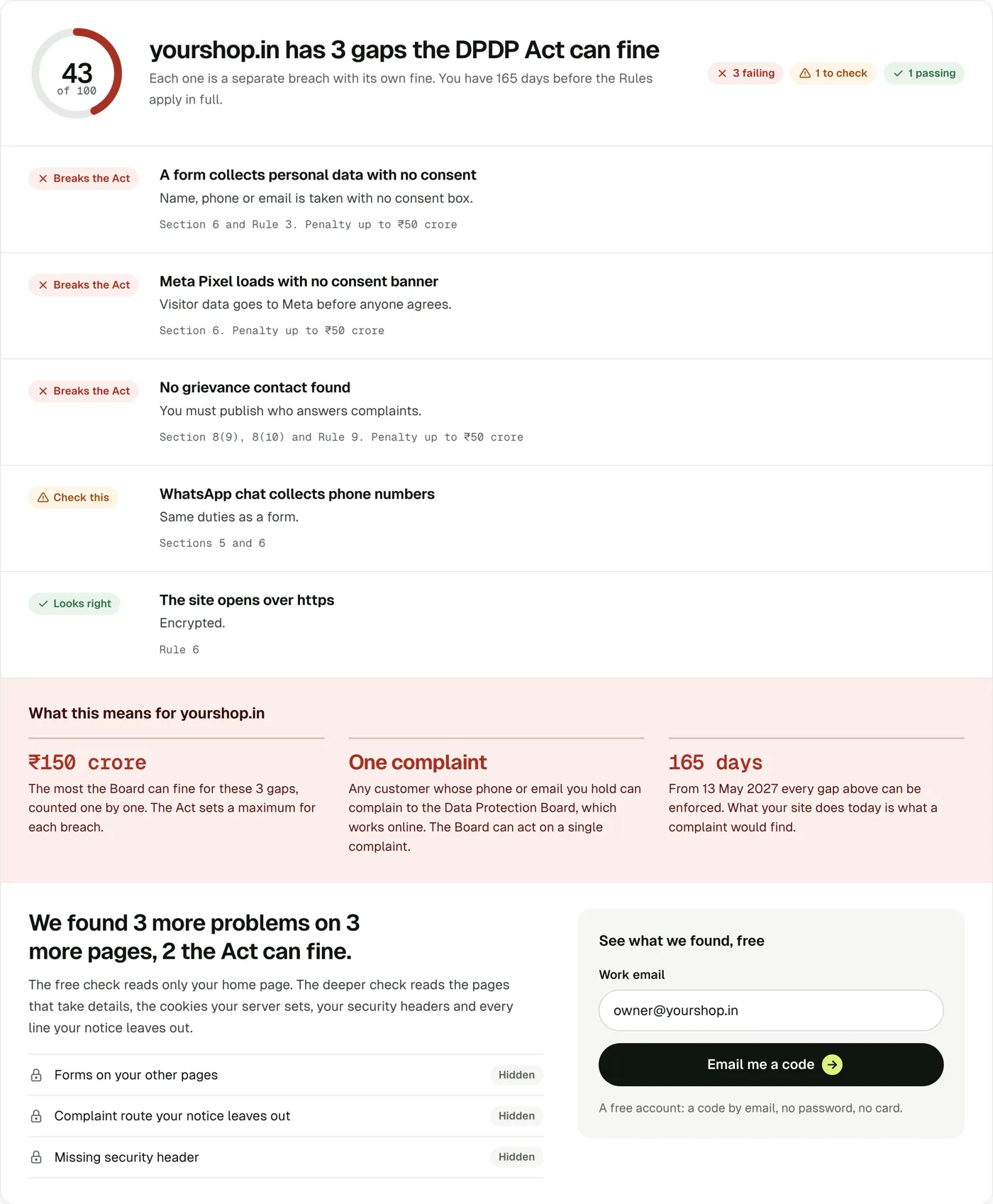
Every gap comes with the section of the Act it breaks and the most it can cost. Below it, what the gaps add up to, and what the deeper check found on the rest of the site.
Eleven things a visitor, a customer or the Board can see on your public pages. Each maps to a section of the Act.
Rule 6
Whether the site opens over an encrypted connection. Anything typed into a plain http page travels unprotected, and weak security carries the highest fine.
Section 5, Rule 3
Whether a privacy link exists, whether it opens, and whether it mentions the DPDP Act or is a European or US template. If none is linked, we try the usual addresses, Shopify's included.
Sections 6(4) and 12
Whether the notice explains how to withdraw consent and how to ask for data to be corrected or erased.
Section 8(9), Rule 9
Whether the home, privacy or contact page names who answers complaints about personal data.
Section 6
Forms on the home page that ask for a name, phone or email, and whether each has a consent box and notice beside it.
Section 6
Google Analytics, Tag Manager, Google Ads, Meta Pixel, LinkedIn, Microsoft Clarity and Ads, Hotjar, TikTok, Snapchat and Zoho SalesIQ, and whether a consent tool is present.
Section 8(1), 8(2)
Google Forms, Typeform, Jotform, HubSpot, Zoho Forms, Tally and Microsoft Forms. Data they collect is still your responsibility.
Sections 5 and 6
Click-to-chat buttons and widgets. Every number that messages you is personal data with the same duties as a form.
Section 9, Rule 10
Words that suggest the site serves students or children. If so, a parent's verifiable consent is needed first, with fines up to ₹200 crore.
Section 5(1)
When the only privacy link is a US, UK or EU version, which does not meet Indian law.
Section 6
CookieYes, OneTrust, Cookiebot, Complianz, Termly, Osano, iubenda, Usercentrics, Consentin and Shopify's privacy banner.
An outside check is a start, not an audit. These still need your attention.
Yes. No sign-up, no email needed, and no limit beyond six checks a minute from one connection.
No. The check reads public pages only. A good score means those pages show no obvious gaps. Your forms, spreadsheets, WhatsApp and staff practices still need consent records, deletion and a breach plan.
Each finding that breaks the Act takes 17 points off 100 and each finding to check takes 6. It is a quick way to compare before and after a fix, not a legal measure.
It is used to fetch the public pages, and the result sits in our network cache for up to an hour. It is not stored in a database or linked to you. See the privacy policy.
The check reads pages anyone can open. Use it for sites you own, manage or are considering working with, and not to attack or embarrass another business.
Some sites block automated visits, or take more than 8 seconds to answer. Check the address, try the version with or without www, or try again in a minute.
Early access members get consent, notices, the data map and deletion requests set up first, at the prices on the pricing page.